Pages

Showing posts with label One Thousand Gifts. Show all posts

Tuesday, October 16, 2012

T.S. Tuesday: Stairway to Joy

In T.S. Eliot’s poem, Ash Wednesday, he describes the climbing of a spiral staircase: climbing, spinning, revisiting the same space, the same struggles, over and over again on a never ending journey up and up.

The figure steps. Climbs. Rounds the corner.
“At the first turning of the second stair
I turned and saw below
The same shape twisted on the banister
Under the vapour in the fetid air
Struggling with the devil of the stairs who wears
The deceitful face of hope and of despair.”
Like Eliot’s figure, I've rounded a corner. I’m here in Guatemala. I've stepped out (or up?) in faith.


But I look back and see the same the shapes, the same hauntings, the same oscillation between hope and despair. I look forward and those stairs look so dang steep and my legs are so tired and I wonder “haven’t I arrived yet?”

I’m working to relinquish burnout. I’m learning to trust the spark. I believe that God will restore my JOY. Not just the joy of his presence, but the joy of participating in work that brings me LIFE. I've been itching, waiting, squirming for joy.

I wanted it the easy way.

I bought a gratitude journal over a month ago. The lines remain blank.

I’ll write them when something really big happens, I reasoned. When joy is restored. When the feelings come rushing back.

I wanted to get whacked with Joy. I wanted healing to be quick. I wanted a big Kaboom. I wanted it big and vivid and unmistakable. And I didn't want to work for it.

God’s big enough, isn't He?

Now, rounding the corner, I pause in the stairwell. I glance back at the familiar figures of discontent, unease, despair.

I've played the woe-is-me-game, and I've won. Which actually means I lose.

It’s a lesson I've learned a thousands times.

As Ann Voskamp writes, “Eucharisteo—thanksgiving—always precedes the miracle.” ― One Thousand Gifts: A Dare To Live Fully Right Where You Are

How do I not know this yet?

I blogged about it all last year. I reaped the fruit of faithful gift charting, joy stacking.

And yet I got here to Guatemala and thought the gifts would be as vivid as the woven scarves and blatant as the bold buildings all around me so I wouldn't need to write them or convince myself of their gift-worthiness.

How could I forget the stacking of gifts, the cataloging of daily delights, is what brings Joy in all its glory?

Not the other way around.

And so I recommit to stacking joy. To stepping forward in gratitude. To building my life on thanks. As I round the corner, pause for a moment on the stairwell, I take a deep breath, grab my journal and pen, and begin to climb again this spiraled stairway to joy.

Tuesday, August 21, 2012

T.S. Tuesday: What a Difference Hope Can Make

“You do not know what hope is, until you have lost it. You only know what it is not to hope.”  T.S. Eliot, Family Reunion
I know what it is not to hope. 

The Guatemala City garbage dump, where hundreds work
 each day to support their families.
Six years ago I came to Guatemala at the end of my semester abroad in Central America. After three months of visiting garbage dumps, hearing rants on U.S. involvement in dictatorial coups throughout Central America, and basically having my entire Christian belief system come crashing down, I was numb and tired. Tired of hearing of injustice. Tired of trying to care.

From the airport in Guatemala City we drove to Seteca, the theological seminary where we would be staying until we separated out again into different groups for a week long work project.  We’d barely had time so to set our bags down and sit down before our professor began yet another belligerent, and yet no longer shocking, tirade about U.S. involvement in Guatemala.  

In a rare act of encouragement, one of our leaders played a song in which the singer confidently declared that in God’s hands her “pain and hurt looked less like scars and more like character.”  We’d been through a lot that semester, but we were developing character, my study abroad program implied.  Character shmaracter, I thought.  What if you no longer believe that God has hands for you to be in?  Or feet?  Or a heart?  Anything?  Had I gone Nietzche on myself?  Could I really believe that God was dead?  

Yep, dead as a doornail.  Or a least in a coma.  

Our professor, Don Mike, continued to rant and rave, we heard from different people involved in myriad types of government positions, toured the city, went to the dump, talked about justice and Jesus and liberation theology. 

Is it so awful to say that after awhile all third world countries start to look the same?  The littered highways, the graffiti-covered concrete buildings, the bars and spikes and security guards with guns.  I wish I could say that I instantly connected with Guatemalans, that it mattered to me that they had been in a civil war for decades.  But I didn’t care about the indigenous, specifically Mayan, influence on the culture or that hundreds of thousands of women had mysteriously lost their husbands and sons, fathers and brothers to midnight kidnappings and mass murders during the war.  I feared there was nothing in me that cared anymore.

I had lost my hope.

Throughout the last six years, I have experienced a Love that saves, a Joy that saves, a Hope that saves. My friends and family and church and coworkers have shown me that my anger doesn’t help the suffering, my hopelessness does not prove my compassion. They have shown me, and God continues to teach me, that Hope brings change, that Joy alleviates suffering, that Love drives out fear.

This time around in Guatemala, although I’ve already heard countless stories of war and violence and injustice, although I’ve already visited the wasteland of the Guatemala City garbage dump, although there are plenty of reasons to shut down and tune out, I will cling to hope. I will look for the bright spots.

I will remember the words of AnnVoskamp in One Thousand Gifts,
“Why would the world need more anger, more outrage? How does it save the world to reject unabashed joy when it is joy that saves us? Rejecting joy to stand in solidarity with the suffering doesn't rescue the suffering. The converse does. The brave who focus on all things good and all things beautiful and all things true, even in the small, who give thanks for it and discover joy even in the here and now, they are the change agents who bring fullest Light to all the world."

This time around I will not be paralyzed. I will not reject joy. I will listen and I will move and I will act. I will engage.

I will not disregard the suffering. I will not turn a complacent eye to their pain. But amidst the pain and horror, I will look for hope. I pray I will be brave enough to “focus on all things good and all things beautiful and all things true.”

So far I’ve seen some incredibly hopeful, transformative work being done in Guatemala. There are so many ways for me to get involved in bringing Hope and Life and Joy to the people around me. But I don’t know quite where to spend my time yet. Despite my commitment to move, I feel a call to be patient, to wait on God’s timing and leading. I pray for wisdom in how to spend my time here. I ask for an open heart to accompany my open schedule.

Kids playing with bubbles in the park in Antigua
As I wait and look for ways to engage, I will share the bright spots that I have seen. Throughout the week, and I imagine beyond this week as well, I will share the stories of hope and redemption and transformation that I have glimpsed. I will write of the miracle of kids being able to be kids in the midst of gang violence and extreme poverty, of women speaking out against injustice and sharing their stories of pain for the first time, of brave individuals seeking alternatives to violence, of people daring to hope and try and move in a place where the problems seem copiously complex and insurmountable.

I know what it is not to hope; this time around I will fix my eyes on the Hope that saves. 

Monday, June 11, 2012

A Monday Morning Pick-me-up

It's Monday morning and I have three weeks left at my job to organize 4 1/2 years of files, emails, and priorities for my successor. In addition to my normal job responsibilities AND completing an extensive government grant proposal--the 176 pages of instructions to submit a six page concept paper should explain my ever amping stress levels.

Needless to say, I'm feeling a little frenzied, hurried, helpless.

I want to reject this moment. This rolling out of bed. The mountain of unending tasks set before me. But I'm reminded of the words of Ann Voskamp in One Thousand Gifts:
"I will not desecrate this moment with ignorant hurry or sordid ingratitude."
When I say

I don't want this task.
I don't want this moment.
I don't want this job.
I am saying
I don't want this God.
And that is not what I want to be saying. That is not how I want to spend this morning or these next few weeks or my life--in ignorant hurry or sordid ingratitude.

Like my favorite Sara Grove's song, I want to "Add to the Beauty" instead of seething in stress.

The lyrics go like this,


And I want to add to the beauty
To tell a better story I want to shine with the light
That's burning up inside
 
This is grace, an invitation to be beautiful
This is grace, an invitation


Yes, it's way too early on a Monday morning, but today is also an invitation to be beautiful.

And so before I hit the cubicle, I will take a moment to give thanks, to see beauty, to stack joy. You can't add to the beauty if you don't see the beauty in the first place.

The accumulation starts with acknowledgement, so before hurry can apprehend, I will stop and count the graces.

Today, Monday June 11, 2012, I am grateful for

  1. The day I get to spend--in the same office!-- with my friend and coworker who usually works from Colorado. Welcome back, Corbyn! 
  2. The chance to laugh and pray together at morning staff meeting.
  3. The opportunity to grab lunch with a coworker before he leaves for Thailand and I leave for Guatemala.
  4. The privilege of inviting others into the life-giving work of Plant With Purpose. 
Thank you thank you thank you thank you.

Now, let's start adding to the beauty!

Friday, May 11, 2012

Goodbye Graces

I've finally done it. I've accomplished a feat I thought would never happen: I finally finished One Thousand Gifts by Ann Voskamp.

Wait, what? you ask. You've been talking up this book for months now and you haven't even read it all the way through?

Guilty as charged. 

When I find a book I love, that speaks my soul language, I can't rush it. Ann's the kind of writer that keeps me occupied with one paragraph, one line even, for days, weeks. 

Her obsession with eucharisteo, with giving thanks, for choosing to see life as gift, will--I hope--keep me occupied for a lifetime. 

Ann writes, "the only thing to rip out the tape echoing of self-rejection is the song of His serenade. One thousand gifts tuned me to the beat."

I've felt it too. One Thousand Gifts has tuned me to the beat. The rhythm of love. The heartbeat of joy. The grace of gratitude. 

It's the antidote to my burnout at work, my dissatisfaction with my body, my stress and busyness and discontent. Even the act of giving thanks is a gift. 

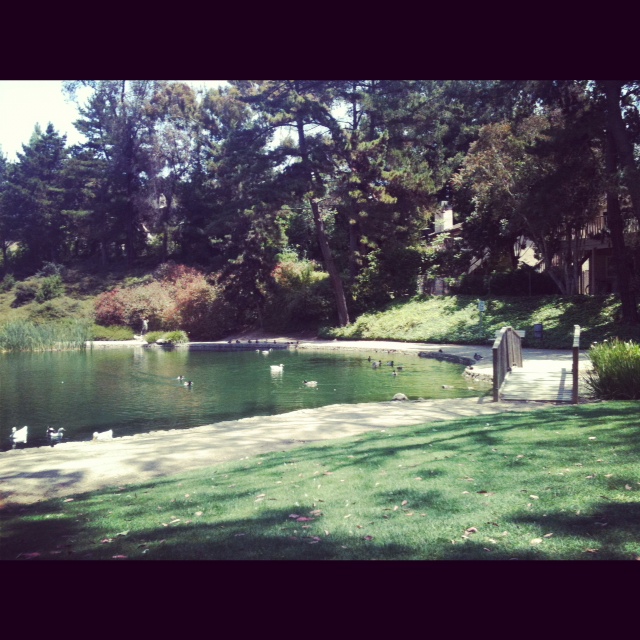
I ended the book, tummy down on a picnic blanket overlooking a duck pond on a reading lunch date I pulled from my "Bucket bucket" which was inspired by Ann's commitment to counting gifts. 

These last two months before I move to Guatemala, leave my job, I am choosing to be present. Out of a bucket of uncertain tasks, I daily embark on challenges that promise certain joy. 

Here's my week of joy in pictures: 


Take a reading lunch break with Becky to the pond--
where I finished One Thousand Gifts.

Write notes to everyone (in the office that is).

Have a picnic on the grass. 

Dress like a coworker day.
I found joy in quiet moments, in spending time with ducks--who doesn't love ducks?--, in slack lining and bocce ball tossing with coworkers, in Bananagrams and note writing. I end this week filled. And for that I am thankful. 

Where did you find joy this week?

Wednesday, May 2, 2012

T.S. Wednesday: The Meaning of Life


“Time past and time future
What might have been and what has been
Point to one end, which is always present.”  
T.S. Eliot, Burnt Norton, Four Quartets

Transitions are tough for me; I think they’re tough for everyone. I’ve spent the last months, nay year, deciding whether I should stay at my job, stay in the country. I’ve oscillated between living in the future, what could be, and the past, what has been and what could have been. Both the memories and the dreams sear vividly across my eyelids as I sleep to the world in front of me, the day before me, the moment that flits by.

My bathroom wall used to don a Lululemon poster that contained—along with myriad other inspirational quotes and phrases—the saying, “Living in the moment could be the meaning of life.”

Before I read Ann Voskamp’s One Thousand Gifts and before I immersed myself in Eliot, I would have chalked the phrase up to pop psychology and over-priced yoga pants propaganda. Not now.

As I contemplate Ann’s excursions into eucharisteo, or thankfulness, in every aspect of her life, I can see her journey to joy, to God, to meaning, is a pilgrimage to living in the moment. To naming the graces. Counting the gifts. Stacking the joy.

The journey to God is the quest to unlearn our clinging to the past. The challenge to relinquish a life lived solely in the future.

Naming gifts brings meaning as the moment is acknowledged, fully lived.

Eliot writes in his poem Burnt Norton,

“What might have been is an abstraction
Remaining a perpetual possibility
Only in a world of speculation.
What might have been and what has been
Point to one end, which is always present.
Footfalls echo in the memory
Down the passage which we did not take
Towards the door we never opened
Into the rose-garden. My words echo
Thus, in your mind.”

I am tired of straining to hear the regretted footfalls thump-thumping against untaken paths. I grow weary of a world of speculation.

And so I will keep at this naming of gifts, this stacking of joy. I will scrawl in my notebook the thanks of the moment:
     * A time of extended merriment with friends old and new.
     *Soft mist blanketing, softening the valley as the miles dart by on quiet freeways.
     *The sharing of stories and journeys and pig cheeks' carbonara.

Another way I will orient myself to the present is by implementing a Bucket List for my last two months at my current job. Instead of withdrawing, disconnecting, and playing the Lame Duck Grant Writer, I will engage. I will create new challenges. I will try new lunch spots with my coworkers. I will write new blog posts. I will dance my butt off at our newly scheduled weekly Wii dance parties.

I will celebrate the past and I will dream for the future, all the while pointing to the present. 

***
Questions: Are you more apt to relive the past or spend your time dreaming and scheming for the future? What helps you live in the present, in the moment? Any suggestions for my work Bucket List?

Friday, March 23, 2012

What about evil?


In my pilgrimage from cynicism to faith, gratitude is my final frontier.

In case you’re new to this blog, I have one exhortation: read Ann Voskamp’s One Thousand Gifts.  This book is “a celebration of grace and a recognition of the power of gratitude”—in the most powerful and compelling language I have ever read. It is my current obsession (besides Hunger Games) and progression in my spiritual journey.

Photo credit: Ann Voskamp

Ann’s words have challenged my heart, but they’ve also challenged my mind. She’s addressed gratitude in the face of injustice, gratitude in the face of the mundane, and gratitude in the face of pain.

But today I ask, what about evil?

Ann writes that ALL IS GOOD. All is grace.

She says, “All God makes is good. Can it be that that which seems to oppose the will of God is actually used of Him to accomplish the will of God? That which seems evil only seems so because of perspective, the way the eyes see the shadows. Above the clouds, the light never stops shining.”

That doesn’t sit well with me.

She asks could it be, “that which feels like trouble, gravel in the mouth, is only that—feeling? What if faith says all is good…I think it. But do I really mean it?”

In my world, there are some things that don’t just feel evil; they are evil.

Death and war and rape and genocide and a million other forms of selfishness and injustice that pepper our world with pain. How are those moments grace, gifts?

I relate to Elie Wiesel, Jewish survivor of the Holocaust and Nobel Peace Prize winner, when he says,

“I feel like screaming, howling like a madman so that the world, the world of the murderers, might know it will never be forgiven.”

Sometimes I hear awful stories and I think I could scream for eternity and it wouldn’t be okay.

I think of catching and stopping warlord Joseph Kony. I think of the incredible victory that will be. But the tens of thousands of children who have been abducted and forced to murder, scream out to me that it will still not be okay. 

That it will never be okay.

But God is reconciling ALL THINGS?

I can’t mean it. I can’t.

Not yet. Or maybe not ever.

Photo credit: The Christian Science Monitor
I can see good and hope and love. I see things being made new everyday. As Gungor says, I know God makes beautiful things out of dust and out of us. But I can’t call it all beautiful—not in my macro-theology.

In my personal micro-theology I can believe it. I can name my own gifts, my graces. I can name my hurt and pain and walk the path to wholeness, to redemption, to beauty.

I can consent to each of us, on our own micro-level, acknowledging the gifts.

But I refuse to gift-wrap the world’s pain in glib statements of gratitude without the victims’ approval.  Like my bloggy friend Adrian Waller commented the other day, I refuse to say, “God causes bad things that are "really" for good.”

I refuse to say that it is okay that this world is so messed up.

I used to think that meant I couldn’t believe in God. Or that I didn’t believe in God.

I used to think I couldn’t be angry and grateful at the same time. That I couldn’t be angry and faithful.

But the other thing I learned from Elie Weisel is that you can.

In fact, I can be angry with God precisely because of my faith in Him.

Elie writes, “I have never renounced my faith in God. I have risen against His justice, protested His silence and sometimes His absence, but my anger rises up within faith and not outside it.”

And so today—from within faith—I wrestle. I protest a world with warlords like Joseph Kony and hot topic issues such as sex trafficking and child soldiers.  I protest the poverty I have seen in the city dumps of Nicaragua and Guatemala and in my own neighborhood in San Diego. I protest the less sexy atrocities of lack of access to land and food and crops that I encounter every day at my work. For a few minutes, I let my growing fears that I’m a Capitol dweller in the circus of the 21st century Hunger Games consume me, and I—in the same breath—I ask,

“Where are you, God?” and “Please rain down your GRACE.”  

Amen. 

***


Can you relate to this tension between anger and gratitude?  Do you think it's possible to be angry at God and remain faithful? I'd love to hear your thoughts!

Thursday, March 22, 2012

ALL IS GRACE


Inspired by Ann Voskamp and Saint Patrick, I have adapted a hymn to remind us, to remind myself, that all is Grace.


Grace with me, Grace before me, Grace behind me,

Grace in me, Grace beneath me, Grace above me,

Grace on my right, Grace on my left,

Grace when I lie down, Grace when I sit down, Grace when I arise,

Grace in the heart of every man who thinks of me,

Grace in the mouth of everyone who speaks of me,

Grace in every eye that sees me,

Grace in every ear that hears me.

To learn more about the original hymn, called Saint Patrick’s Breastplate, Click Here. 


Tuesday, March 20, 2012

T.S. Tuesday: Shall


In my writing this week about the God of movement and transformation and transfiguration, one of my favorite T.S. Eliot lines has been illuminated.

Believe me.

This. is. ground. breaking.            

These words are a part of me. They flow involuntarily from my lips, like curse words and Help-me-Jesuses from the mouths of the shocked and endangered.

My favorite phrase from all of Eliot’s poetry (and that's saying something) has been transformed. 

“And so the darkness shall be the light
And the stillness the dancing.”

I noticed a new word the other day.

The darkness SHALL be the light.


Shall—like, not yet.

Not yet.

That's not how I pictured it. With Eliot’s poetic prowess, his omission of the second “shall be” in the phrase “The stillness the dancing,” stillness and dancing became one in my mind. The words interchangeable in the syntax; the images interchangeable in my mind.

The phrase evokes a sense of darkness = light. Stillness = dancing.

But that’s not what Eliot says.

Darkness BECOMES light.
Stillness BECOMES dancing.

As Ann Voskamps puts it in One Thousand Gifts, they are transfigured.

“Darkness transfigures into light, bad transfigures into good, grief transfigures into grace, empty transfigures into full.”

Darkness transfigures into light. Stillness transfigures into dancing.

Darkness ---> Light
Bad ---> Good
Grief ---> Grace
Empty ---> Full
Stillness ---> Dancing

Eliot’s not calling us to pretend that we see things we don’t or to imagine that our motionless bodies are boogie-ing. But to anticipate. To be patient. 

Because “the darkness SHALL be the light and the stillness the dancing.”

And this, this is comforting. 

Monday, March 19, 2012

The Problem With “God Showed Up”


I ended my last post with the climactic, “God showed up,”—as if He had been in hiding, as if He wasn’t always there.

I live in fits of wakefulness, drifting in and out of God-consciousness. Even now, though my tongue doth confess my focus doth protest.

I flit. I flounder.

Some mornings the medley of blanket and body heat are enough to remind me that the day does not belong to me. That I do not go it alone.

But other days, I groan. I stretch.  I snooze. Refusing to open my eye to the God-gifts in front of my face, beneath my toes, the gift of my toes themselves.

But mostly I’m just busy. Tired. Preoccupied, as if I have something more important to occupy myself with than noticing the presence of God.

Naming the presence of God is a different discipline entirely, requiring rigor and hawk eyes for grace.

Most days I’m not up to the task.

But Ann Voskamp in One Thousand Gifts pushes me forward, taunting me with her joy-filled list. She is “Ann full of grace” beckoning to an “Aly full of grace.”

Will I follow?

Today I do.

Today I hunker down to wake up my God-conscious.

I am buzzing on the high of answered prayers, of God-shows-up-because-He-never-left-revelations. I can choose to see Him in the Now. I can choose to see Him moving forward. I try to discipline my mind to believe that He was always there.

I stop short. I pause long.

There when I didn’t see Him?
There when I didn’t want Him?
There when all I felt was pain?

I try to rewrite history. I strain to hear Him speak into the life of the Aly who did not confess His name. I hear the voices that haunted me for years. Voices that condemned and taunted and paralyzed. Voices that kept me self-focused and shuddering. Voices I thought, at my worst, were His. That hissed fire and wrath and brimstone and disappointment. And then guilt for not feeling loved.

And I wonder, where was He in that? He is in the transformation, but is He in the ugly? Did he create the ugly? Orchestrate it? Or allow it?

I can see how I got here. I know it was Grace. Grace the mechanism, Grace the process, Grace the end. But why the humble beginning? Why the dark days?

Why does God need darkness to bring forth light?

I cling to the God of transformation as I read Ann’s hardest chapter yet, asking the hardest questions.

She asks, essentially, “How to lay the hand open for this moment’s bread—when it will hurt.”

What of pain and death and evil and the overwhelming sense of NOT ENOUGH?
Where is God’s grace then?

When her son injures his hand, when he narrowly misses missing fingers, losing a whole hand, her mother whispers, “God’s grace.”


She replies, retorts in this internal dialogue that resonates with the entirety of my being, of my experience, of the questions we’ve all thought and fought and whispered from the pit of fear burning into our stomachs,
“And if his hand had been right sheared off?
What’s God’s grace then?
Can I ask that question?”

What about the times it doesn’t feel like God showed up?

Ann begins to question even her naming of gifts, of graces, of blessings, her family’s “life story in freeze frames of thanks.”

She asks, “If I name this moment as gift, grace, what is the next moment? Curse? How do you know how to sift through a day, a life, and rightly read the graces, rightly ascertain the curses?”

Surely if there are gifts there must be curses. Things intended for ill.

I will write more on my take on evil and curses and other such lighthearted topics later in the week. BUT, today I will soak in the lesson that God is teaching Ann: that 

ALL is good.

The good gifts we greedily grasp and the pain we skirt and sidestep and dispute.


She writes of a God who “longs to transfigure all, no matter how long it takes.” Who transfigures the ugly into the beautiful, redeeming the ugly, redeeming the broken, redeeming the pain.

No matter how long it takes.

Most times it’s longer than I have the patience for. But I know this God of transformation and movement and redemption. Do I trust Him? Do I trust Him to redeem all things, transfigure all things, reconcile all things?

I hope I do. I know I’m trying.

Because—despite my feelings—I know that God doesn’t show up or not show up. I know that in Him I move and breathe and have my being. My very breath is the essence of His presence.

I live in fits of wakefulness, drifting in and out of God-consciousness. I ask you, God, to awake my eyes.
 ***
Do you believe that God is always there? Always working to reconcile all things? When is it hardest for you to believe that? 

Tuesday, March 13, 2012

T.S. Tuesday: More Than Enough

I’m back to reading Ann Voskamp’s One Thousand Gifts. So today is my Voskamp/Eliot mashup, if such a thing is possible.

I huddle in my sheets, drinking my coffee as I read,

“I awake to I AM here. When I’m present, I meet I AM, the very presence of a present God. In His embrace, time loses all sense of speed and stress and space and stands so still…and holy.
Here is the only place I can love Him.”

When I say,
          I don’t want this day
          I don’t want this moment
          I don’t want these tasks or this conversation or this job

I am saying, I don’t want this God.

This I AM that is present in the moment. That is Himself the present tense.

I start. I flinch. My coffee jolts.

Is that what I’m saying?

When I reject the present, I reject the I AM.

The I AM in the moment.

He is present in every one. In every moment.

My very breath proof of His presence.

I flash to Eliot, a phrase from Burnt Norton that caught my heart many years ago: “Wind in and out of unwholesome lungs.”

I am the unwholesome and He is the wind. In and out. In and out. In the rhythm of I AM.

All day I try to embrace the moment. I really try. I write notecard reminders. I consecrate my desk and my space and my tasks.

Dissatisfaction oozes in.

They can’t occupy the same space: gratitude and discontent.

I can only see the NOT ENOUGH.

Ann has a cure for this too.

She recounts the story of Jesus feeding the masses with the not enough of loaves and fishes. A phrase jumps out to her, this woman “sleuthing for glory.” She sees right there in the text that before the miracle, before the full bellies, before the multiplication of the not enough, HE GAVE THANKS.

She writes,

“Gave thanks…I’d missed it and all of my life?
I’d never considered those two words, the bridge words there in the middle, the crossing over that took the not enough and made it enough.”

Gave thanks.
Counted gifts.
But, I protest, I can’t give thanks until I know what the future holds. Thankfulness is bondage to complacency. Saying things are okay right now ensures certain paralysis, right?

I am born to move and grow and learn and leave. Where does thanks fit in?

I don’t give thanks because I feel this moment, this circumstance, is not enough.

But wait. Isn’t that what Ann just said?  The moment of not enough is precisely when Jesus gives thanks.

“Jesus embraces his not enough…He gives thanks…And there is more than enough.”

Later that day I am at the beach. Saved by daylight savings and one more hour of sun and surf and life. I run, I splash, sand wedges its stubborn way into my shoes. Children erupt in squeals of cold and glee, emerging from the emerald waves with strands of shimmering seaweed. 

I reach a doggy beach painted with doggy paw prints with doggy yips and doggy paddles under a piercing blue sky of endless doggy summer. I stop my body, but my breath pants on, the wind in and out of unwholesome lungs.

And at last I gasp, give thanks, “It is more than enough.”

I am born to move and grow and learn and leave. This gratitude in motion is second nature. It's the sedentary thankfulness that will require more discipline.

Today I write more notecards. I consecrate my desk and space and time once again. Calm in my-not-so-ergonomically-designed desk chair, I force myself to notice my quiet breaths: wind in and out of unwholesome lungs.

And give thanks, waiting for the more than enough. 

Thursday, February 16, 2012

A Better Answer

This is a follow up to yesterday's blog post, Solidaridad, which I suggest reading first. 
***
"I know there is poor and hideous suffering, and I've seen the hungry and the guns that go to war. I have lived pain, and my life can tell: I only deepen the wound of the world when I neglect to give thanks for early light dappled through leaves and the heavy perfume of wild roses in early July and the song of crickets on humid nights and the rivers that run and the stars that rise and the rain that falls and all the good things that a good God gives. Why would the world need more anger, more outrage? How does it save the world to reject unabashed joy when it is joy that saves us? Rejecting joy to stand in solidarity with the suffering doesn't rescue the suffering. The converse does. The brave who focus on all things good and all things beautiful and all things true, even in the small, who give thanks for it and discover joy even in the here and now, they are the change agents who bring fullest Light to all the world." from Ann Voskamp’s masterpiece, One Thousand Gifts


This, this is the better answer to my haunting question: What does it mean to live in solidarity with poor?


“Rejecting joy to stand in solidarity with the suffering doesn’t rescue the suffering.” 


How I wish someone had whispered this truth to me when I first opened my crowded closet; when I first swiped my ATM card for apricot face scrub and a new roll of floss at Target; when I first felt the summer sun warm up my parent’s patriotic front yard.


"It is joy that saves us..."

How I wish our study abroad discussions around solidarity had ventured beyond fair trade shopping and SUV bashing and into the fine art of learning to love our neighbors—poor or 1% or anywhere in between.


"Why would the world need more anger, more outrage?"

I mean, how are we supposed to love the poor if we don’t love ourselves? What kind of improved quality of life are we lobbying for if we can’t even recognize the God-like qualities in our suburban Christian friends?


I learned this lesson the hard way. Floundering and seething in an anger that quickly wore out its welcome.  In an anger that helped neither the poor nor the poor saps around me.

My first real step toward living in solidarity with the poor (on which I still have an immensely long way to go) was when I started to live in solidarity with myself. When I started to live in solidarity with my immediate neighbors. When I started to think that I was worth loving and that, maybe, the people in front of me—my Whole Foods Shopping, Invisible Children v-neck wearing peeps and my less well-versed in the rhetoric and fashion requirements of social justice friends and family alike—were worth loving too.

Solidarity began when I asked myself, like Ann Voskamp, Where can I bring life? Where can I choose hope?

How can I become the brave soul who focuses “on all things good and all things beautiful and all things true, even in the small?” Where can I “discover joy even in the here and now?”

The surprising answer to the solidarity question is this: joy.

And in that joy comes a valuing of all human life and all of Creation, a heart that hopes, eyes that see the gifts, and lips that praise the Gifter.  This is the foundation of solidarity. This is the seed that blooms the hope to sustain a multitude of change agents bringing fullest Light to all the world.

Who wants to live the better answer?


***


P.S. I am still stubbornly passionate (although no longer belligerent) about reducing my injustice footprint and learning to live and act in ways that serve, support, and empower the poor.  I would love to talk shop with anyone interested in living more justly, sustainably, and joyfully.

But how, you ask?

You can read more of my thoughts in my post on fighting both first world apathy and third world poverty or dive into 7 Practical Tips (and delicious writing) from Jen Hatmaker, author of  "7 : An Experimental Mutiny AgainstExcess."  Or check out Julie Clawson’s fabulous book, EverydayJustice. Or find out more about my favorite poverty alleviation non profit that I just so happen to work for: Plant With Purpose.